Views: 0 Author: Site Editor Publish Time: 2026-07-03 Origin: Site


Sourcing commercial plumbing fixtures requires balancing long-term durability with an unforgettable guest experience. Hospitality projects demand fixtures that look stunning while surviving constant daily use. Guests interact with these elements directly, making them a crucial touchpoint for your property’s overall design impression.
Unlike residential choices, selecting a basin faucet for a hotel project requires evaluating high-traffic resilience. You must also navigate strict compliance standards and streamline maintenance protocols for your housekeeping teams. Choosing poorly leads to water damage, early replacements, and negative guest reviews.
This guide provides a technical evaluation framework for procurement teams, designers, and developers. You will learn how to specify the right fixtures, calculate optimal spout geometry, and vet reliable manufacturing partners. We will explore mounting configurations, core engineering standards, and splash prevention strategies to ensure flawless project execution.
Material matters most: Solid brass construction with ceramic disc cartridges is the baseline for commercial viability and leak prevention.
Mounting dictates maintenance: Wall-mounted fixtures elevate aesthetics but increase installation complexity and maintenance downtime compared to top-mount designs.
Geometry prevents liability: Proper arc height and spout reach must be calculated against the sink basin to prevent splashing, water damage, and slip hazards.
Compliance is non-negotiable: Shortlist only fixtures that meet ADA operational standards and commercial water-efficiency certifications (e.g., WaterSense, LEED).
Specifying a hotel bathroom faucet means understanding the rigorous demands of hospitality environments. Residential fixtures fail quickly under commercial conditions. You must look beyond exterior designs and evaluate internal engineering.
A standard residential fixture might experience operation a dozen times daily. Hotel environments subject hardware to relentless use. Guests operate handles with varying degrees of force. The internal components face continuous water pressure changes and aggressive daily handling. Lobby restrooms experience even higher volumes, enduring hundreds of daily activations. We must specify fixtures engineered specifically for commercial volume. Weak internal components will fail under this constant stress, leading to leaks and out-of-order rooms. True commercial fixtures utilize heavy-duty metal internals designed to withstand aggressive, repeated movements without loosening or degrading.
You cannot compromise on local and federal compliance standards. Shortlisting fixtures begins with confirming regulatory adherence. ADA compliance remains mandatory for all commercial hospitality spaces. You should choose lever handles over standard knobs. ADA guidelines require operable parts that users can manipulate using one single hand. They must not require tight grasping, pinching, or twisting of the wrist. Furthermore, the activation force cannot exceed five pounds.
Flow rate restrictions also play a critical role in fixture selection. Sustainability certifications like LEED depend heavily on indoor water efficiency. WaterSense standards typically mandate flow rates around 1.2 to 1.5 gallons per minute (GPM). Every bathroom basin faucet installed in your property must balance this guest comfort with local environmental restrictions. A well-engineered aerator creates the illusion of high volume while adhering to strict GPM limits.
The mounting style you select fundamentally impacts the installation timeline and long-term upkeep. Design teams often push for visually striking setups. Facilities teams prefer setups that allow rapid repairs. You must find the correct balance for your specific project type.
This configuration mounts directly onto the vanity counter or sink deck. It represents the industry standard for most hotel properties.
Use Case: Standard vanity designs, undermount sinks, or traditional drop-in basins.
Advantages: They provide streamlined installation. Plumbers can rough-in the supply lines quickly. They offer immediate access to supply lines for maintenance staff. If a unit fails, facilities can swap cartridges or replace the entire unit with minimal room downtime. They are easily retrofitted during property renovations.
Considerations: They require adequate deck clearance for cleaning. Housekeeping teams need room to wipe behind the fixture base. Without proper clearance, hard water buildup accumulates quickly around the escutcheon plate. You must pair a top mount basin faucet with a vanity depth that accommodates comfortable hand washing.
Wall-mounted designs float above the counter. They emerge directly from the vertical wall surface, creating a seamless and highly customized look.
Use Case: Luxury suites, premium spa areas, minimalist aesthetics, and vessel sink pairings.
Advantages: They completely clear the counter space. They look visually striking and sophisticated. Housekeeping teams love them because they allow incredibly easy vanity surface cleaning without obstacles.
Implementation Risks: They require highly precise in-wall valve installation during the rough-in plumbing phase. Miscalculations lead to costly tear-outs and delayed schedules. Maintenance access remains severely restricted. Repairing a significant leak might require opening the drywall or accessing a rear plumbing chase. You must ensure structural blocking inside the wall can support the heavy brass components.
Evaluation Criteria |
Top Mount (Deck-Mount) |
Wall Mount |
|---|---|---|
Installation Speed |
Fast. Standard hole drilling applies. |
Slow. Requires precise in-wall valve positioning. |
Maintenance Access |
Excellent. Valves easily reached under vanity. |
Poor. Often requires wall access panels. |
Vanity Cleanability |
Moderate. Base requires detailed wiping. |
Excellent. Completely clear deck space. |
Ideal Sink Pairing |
Undermount, Drop-in. |
Vessel sinks, Trough basins. |
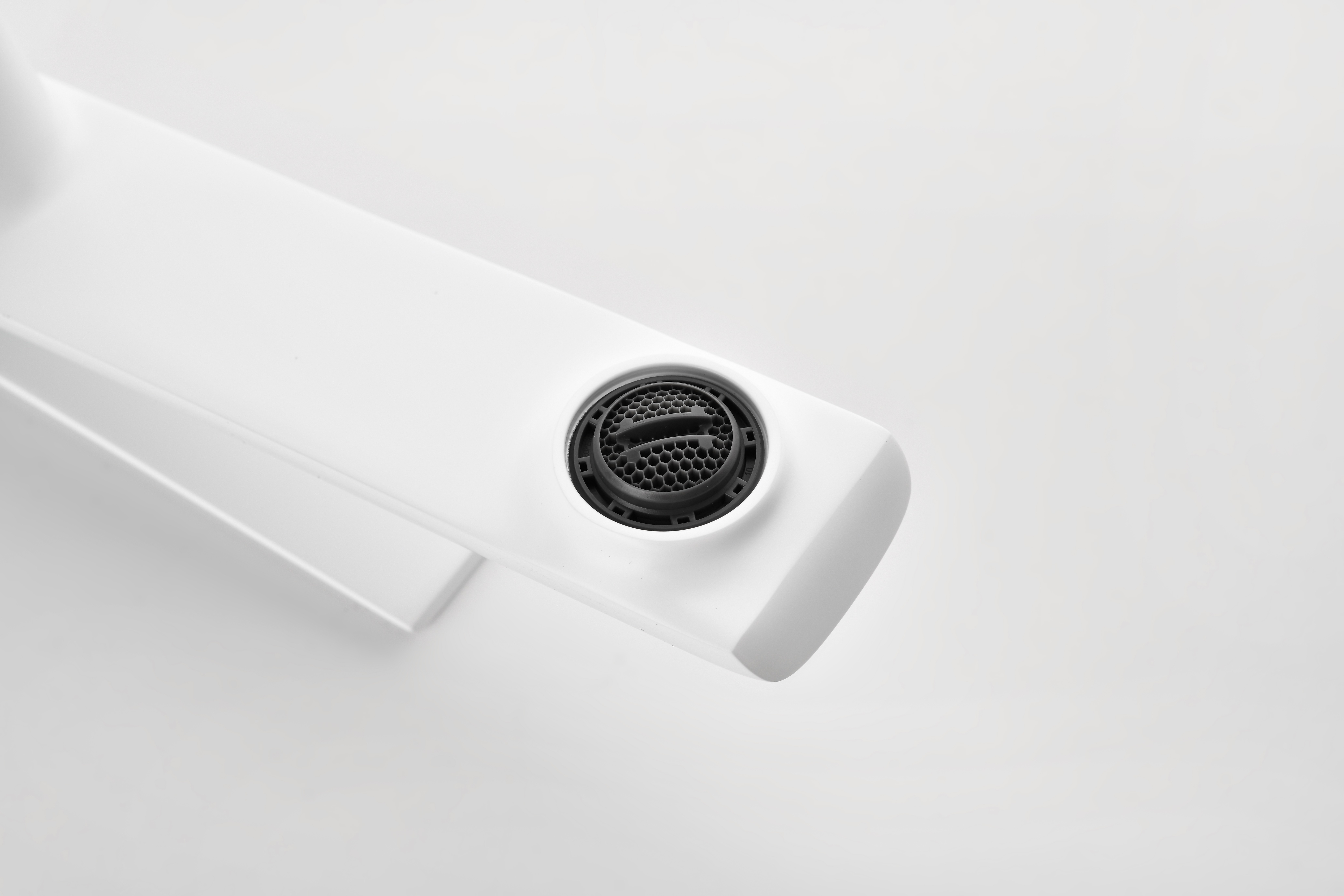
You cannot judge a commercial fixture by its exterior shell alone. The internal metallurgy determines its lifespan. When procuring for hundreds of rooms, minor material compromises result in major operational failures.
We universally recommend solid brass for commercial use. A true brass basin faucet offers superior corrosion resistance. It handles sudden high-pressure water spikes far better than zinc alloys or plastic internal bodies. Zinc alloys corrode from the inside out when exposed to hard water. Plastics degrade, become brittle, and crack under commercial stress. A solid brass body ensures permanent structural integrity. Look for dezincification-resistant (DZR) brass alloys if your property is located in an area with highly aggressive water chemistry.
The valve acts as the engine of your fixture. You must specify ceramic disc cartridges. They withstand high-volume, aggressive usage without dripping. Older rubber washer designs wear out rapidly through friction, causing endless maintenance tickets for drips. Ceramic discs consist of two fired-clay plates that slide against each other. They create a watertight seal that ignores debris and resists mineral buildup. A quality ceramic cartridge delivers millions of drip-free cycles.
Hospitality environments rely on harsh commercial cleaning agents. Standard residential finishes tarnish, peel, or scratch under this daily chemical assault. You must evaluate finish applications rigorously.
Physical Vapor Deposition (PVD): Always highlight PVD coatings for your commercial specs. The PVD process vaporizes the finish material and bonds it to the brass body at a molecular level. It creates a surface highly resistant to scratches, tarnishing, and chemical corrosion.
Fingerprint-Resistant Options: Consider finishes like brushed nickel, satin stainless, or matte black. High-gloss chrome shows every water spot and fingerprint. Brushed finishes reduce housekeeping turnaround times by hiding minor smudges.
Un-lacquered Living Finishes: Avoid these for standard guest rooms. Living brass patinas beautifully but looks dirty to guests if not polished daily. Reserve these only for highly controlled specialty suites.
Beautiful design fails if guests soak their clothes while washing their hands. Water damage destroys expensive vanities and creates dangerous slip hazards. You must calculate precise geometric relationships between your fixture and your basin.
You must match the fixture to the sink depth and drain placement. A massive, high-flow fixture overwhelms a small, shallow sink. Conversely, a tiny fixture on a massive vanity looks awkward and forces guests to press their hands against the basin wall. Always align the spout reach with the sink's center point.
The arc determines vertical clearance and aesthetic impact.
High-Arc: These feature a tall, sweeping neck. They are ideal for pairing with vessel sinks. However, they require precise alignment with the drain. The increased drop distance means water hits the basin with higher velocity, increasing splash risks on countertops.
Mid-Arc: This serves as the standard hotel choice. It provides comfortable hand-washing clearance without excessive drop velocity.
Low-Arc: Better suited for very shallow undermount sinks. They minimize splash risks perfectly. However, they require careful measurement to ensure guests have adequate hand-washing space beneath the aerator.
The "drop zone" engineering formula remains crucial. The water stream must hit directly over the drain, or slightly behind it. It should never hit the sloping front wall of the basin. When water strikes the porcelain slope directly, it deflects outward onto the guest. You must calculate the spout reach accurately. Mandate that your design team reviews cross-section drawings of the vanity, basin, and fixture together before finalizing the specification.
Common Mistakes to Avoid:
Failing to account for the thickness of the vanity top when calculating undermount sink depth.
Positioning a wall mount basin faucet too high above a shallow trough sink.
Ignoring aerator angles. Some spouts angle the water stream outward, drastically changing the expected drop zone.
Choosing the right hardware represents only half the battle. You must vet a supplier’s ability to deliver consistent quality across a massive order. A delayed shipment of 500 fixtures can derail an entire hotel opening schedule.
You must vet the supplier's actual manufacturing capacity. Can they maintain uniform finish and machining quality across a 500-room order? Small boutique brands often struggle with volume consistency. Request documentation of their quality assurance processes. Ask how they handle batch color matching, especially for PVD and matte black finishes. Variations in finish across different floors of the same hotel reflect poorly on procurement.
A constant tradeoff exists between off-the-shelf SKUs and custom-branded designs. Custom designs give your property a unique signature. However, they require extensive tooling and longer production runs. Off-the-shelf items ship faster and offer reliable historical performance data. If you choose bespoke finishes, establish safe buffer timelines. Always pad your construction schedule by several weeks to accommodate unforeseen supply chain disruptions.
A warranty document means nothing if you cannot get parts. Evaluate the availability of replacement cartridges, handles, and aerators. A 10-year warranty is useless to a hotel engineer if replacement parts have a 12-week lead time. The supplier must maintain domestic inventory of critical wear parts. Ask the manufacturer for their standard replacement part fulfillment timeframe.
Never place a bulk order based on a catalog photo. Mandate a "mock-up room" installation.
Test water pressure compatibility on-site.
Test actual splash dynamics using the property's standard water pressure.
Solicit direct feedback from the housekeeping staff. Do they struggle to clean around it?
Check handle operation for smooth, ADA-compliant movement.
This physical testing protocol isolates design flaws before you commit to purchasing hundreds of units.
Reiterate that choosing the right basin fixture remains a highly localized decision. It depends entirely on your specific vanity type, your internal maintenance capabilities, and your brand's overarching aesthetic. There is no universal perfect choice, only the perfect choice for your specific operational reality.
To ensure success, advise your procurement teams to take the following next steps:
Request comprehensive technical spec sheets (cut sheets) for every shortlisted fixture.
Strictly verify ADA compliance documentation and independent flow rate certifications.
Order physical samples to construct an on-site mock-up room for pressure and splash testing.
Confirm the manufacturer's inventory levels for spare ceramic cartridges and aerators.
A: The standard flow rate generally falls between 1.2 and 1.5 gallons per minute (GPM). This range perfectly balances guest comfort with mandatory water efficiency limits. Facilities must adhere to these metrics to achieve sustainability certifications like WaterSense or LEED without making the water stream feel inadequate for hand washing.
A: Single-handle models offer easier ADA compliance, faster one-hole installation, and quicker surface cleaning. They dominate modern hospitality designs. Widespread (three-hole) models offer a traditional, high-end luxury feel. However, they require more complex plumbing connections and demand significantly more cleaning effort from housekeeping staff around the separate handles.
A: You must calculate the drop distance carefully. Pair a tall deck-mounted or wall-mounted fixture with a deep basin. Ensure the aerator height sits no more than 6 inches above the sink rim. Additionally, align the water stream to hit directly over the drain rather than the sloping porcelain walls.
A: We strongly recommend brushed, satin, or PVD-treated finishes. Brushed nickel and matte stainless steel naturally hide fingerprints and minor water spots. You should avoid high-gloss chrome or un-lacquered living brass, as they show heavy water spots instantly and require constant, intensive daily polishing to look acceptable.